

 Article
by
One of my niche hobbies is studying how studio music is made. Not all music. Just the really influential songs. And in 1968, Glen Campbell released a song titled “Wichita Lineman” that more than one musical genius has dubbed “perfect” or “the best ever written” (note that the song was written by Jimmy Webb but Glen knocked it out of the park with his performance). Naturally, if a song has that kind of street cred, I had to dig into what makes it so special.
Some might say it’s the subject matter. Making a hero and romantic lead out of a blue-collar worker in Kansas. Telling a story in a way that only country music seems to be able to tell it. For me, it’s this two-line punch that knocks the wind out of me every time:
“And I need you more than want you,
and I want you for all time.”
What is it about that phrasing? I had to figure it out. Turns out, it has a name. Contrastive parallelism, a poetic device defined as, “Setting up an apparent contradiction or tension in the first part of the sentence, and resolving it in the second half of the sentence.”
For me, that line took me right back to the couch in my abusive father’s living room, sitting there as he paced the floor in a screaming lament about how if he only had custody of me, he wouldn’t have to pay the child support.
He needed me more than he wanted me. But unlike that Wichita Lineman, he didn’t want me for all time.
Left with only that one adult in my life, my self-image could have completely dissolved. There’s no telling where I would have ended up. But the tension was resolved, as it does in contrastive parallelism. The loving, caring adults in my sphere of influence became my village. A football coach saw something in me, gave me a chance, and intentionally told me, in front of my teammates in a way I would never forget, that I had earned a spot on varsity. Without saying the words, he told me, “Pick up your chin. Lift your eyes. You’re valuable.” And the men and women of my church pulled me in close and taught me where my true worth lies — in Jesus Christ. Paul was a master of contrastive parallelism.
Romans 6:23 says:
For the wages of sin is death.
But the tension is resolved in the next line:
But the free gift of God is eternal life in Christ Jesus our Lord.
We would be doomed to death by sin, BUT, we have the choice to accept the gift of eternal life with God. Our children live in a world that could surround them in loneliness and isolation; YOU can show kids they belong to God in a way they’ll never forget.
The Bible is one big story — God’s real, factual history. And we, each of us, have a place in it. That’s what the disciplemakers in my life taught me, and it gave me a place to plant my feet. In a secular river that could sweep me downstream and pull me under the current, tumbling til I don’t know which way is up, I stood on the foundation of the Gospel. You ARE contrastive parallelism, in living color. YOU can help build lasting faith in the children in your ministries, and help parents give that same gift to the children in their homes.
How Do You Resolve the Tension?
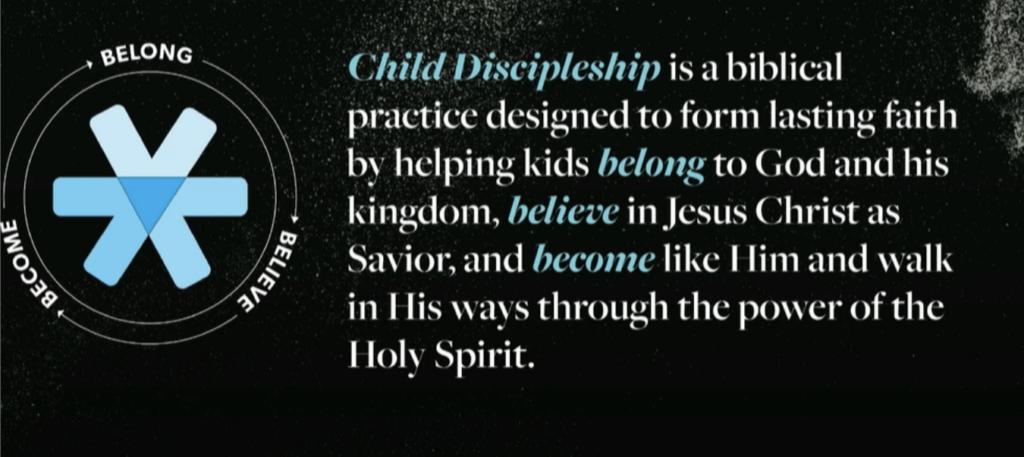
How do you build lasting faith? Kids need “Become” — the third “B” of the 3B child discipleship philosophy. They need to know how to experience God’s presence and walk in the ways of Jesus. They need to become more like Him.
What you’re doing is the most important work on the planet. Research from the Center on the Developing Child at Harvard University has shown that “the single most common factor for children who end up doing well is having the support of at least one stable and committed relationship with a supportive parent, caregiver, or other adult.” And when children have loving, caring adults other than their parents, who bring them into the fold and help them know they belong to the Creator of the world, it changes everything for them. That relationship, in the midst of a corrosive culture, can form lasting faith and keep children on the narrow way all the way into eternity.
My childhood church, where I first trusted in Jesus, is in the process of being torn down. But a hardhats-only zone and a construction manager who told me the site was closed and locked for the day couldn’t stop me from going in to stand in the spot where that Holy Moment of my life took place. I found the exact room, and every detail of that moment came back to me. You know how many people were in the kids’ ministry that day? Four. Low numbers, inconsistent volunteers, the lack of a fancy curriculum or Disney-esque kids’ wing — those factors may affect your morale some days — but know this: The Holy Spirit is in your ministry, resolving that tension by working through you and in the children in your circle.
You are poetry in motion.
Learn more about Become in your ministry (and catch some fresh pics of ’80s versions of Awana leaders).
